
In regions across the Middle East, South Asia, Latin America, and Europe, WhatsApp is not simply a casual messaging app — it is the primary transactional interface through which business occurs. Customers expect instant sizing assistance, order status notifications, and appointment rescheduling directly inside their active WhatsApp threads.
Yet, hundreds of businesses still manage WhatsApp by having physical human staff pass around shared company smartphones or open dozens of WhatsApp Web tabs. Inevitably, messages are missed during off-hours, customer data is never recorded in the central CRM, and fulfillment delays skyrocket.
1. Architecture Overview: The Event-Driven Pipeline
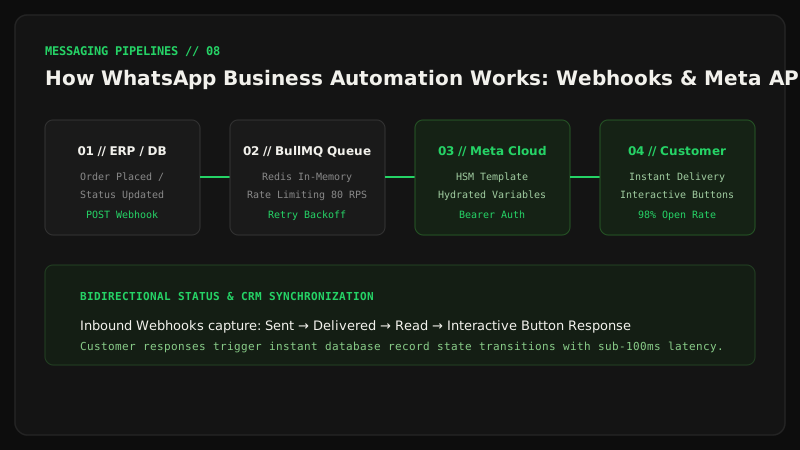
True enterprise WhatsApp automation bypasses the consumer app entirely and interfaces directly with the Meta WhatsApp Cloud API via event-driven microservices. The architecture consists of four distinct decoupled layers:
- Webhook Listener Layer: A high-throughput Node.js/Go endpoint that receives real-time event payloads from Meta (messages, delivered receipts, read statuses, interactive button clicks) and validates cryptographic SHA-256 HMAC headers.
- Asynchronous Queue Worker (BullMQ / Redis): Prevents webhooks from timing out under sudden traffic spikes. Payloads are placed into an in-memory Redis queue for guaranteed sequential processing with exponential backoff retry.
- Business Logic Engine: Evaluates the incoming message against customer records in PostgreSQL, checks whether an active 24-hour service conversation window exists, and determines the automated response.
- Outbound Dispatcher: Signs and sends approved Meta HSM (Highly Structured Message) templates or freeform session messages with sub-200ms latency.
2. HSM Templates vs. 24-Hour Session Windows
Meta enforces strict policy controls on commercial WhatsApp messaging. If a business initiates contact with a customer (e.g. order confirmation, dispatch notice, or appointment reminder), it MUST use a pre-approved HSM template containing dynamic variables like {{1}} (Customer Name) and {{2}} (Tracking URL). Once the customer replies, a 24-hour freeform messaging window opens, allowing AI conversational agents or support desks to exchange custom text, documents, and media without template restrictions.
3. Bidirectional CRM Synchronization in Real-Time
The real value of WhatsApp automation is closing the loop with your core operational database. When a customer taps an interactive quick-reply button saying "Confirm Cash on Delivery", the webhook listener captures the callback payload, immediately updates the order status in Postgres to "Confirmed", and alerts the warehouse dispatch team — with zero human intervention.
“With open rates exceeding 95%, WhatsApp is the most powerful communication channel in modern commerce. But without event-driven architecture, scaling it breaks human operations.”