
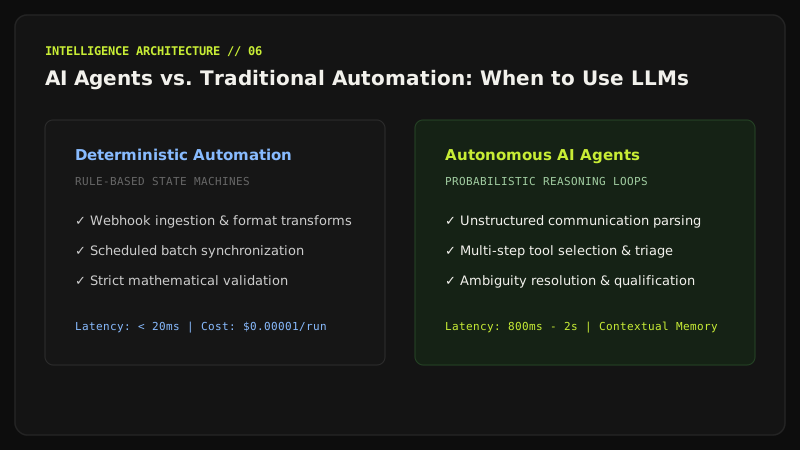
In the rush to adopt artificial intelligence, businesses frequently make one of two catastrophic architectural errors. The first is trying to force traditional rule-based scripts to handle messy, unpredictable real-world inputs — like parsing unstructured customer WhatsApp inquiries or evaluating lead purchase intent. The scripts inevitably break whenever a customer typos a word or uses unexpected phrasing.
The second error, which is far more expensive in 2026, is wrapping an LLM around every single step of a workflow. Using an AI model to perform basic arithmetic, route predictable database IDs, or format standard JSON objects adds 800ms of unnecessary latency, consumes expensive token credits, and introduces non-deterministic hallucinations into critical business pipelines.
The Fundamental Difference: Determinism vs. Probability
Traditional automation is deterministic. Given input A, rule B will execute every single time with 100% mathematical certainty in under 15 milliseconds. Examples include: syncing an approved Stripe invoice to QuickBooks, sending an SMS notification when an order status changes to "shipped", or triggering a database backup at midnight.
AI agents are probabilistic reasoning loops. They excel when the input is fuzzy, semi-structured, or ambiguous, and the system must dynamically decide which tools to use to accomplish a goal. Examples include: reading an inbound enterprise email inquiry, determining whether the sender is an authorized decision-maker, researching their company domain, and generating a customized contract proposal.
The Hybrid Architecture: State Machine + Reasoning Node
At ZYVONE, we design enterprise automation as hybrid state machines. The backbone of the system is built with deterministic, strongly typed code (Node.js/TypeScript or Python with Redis queues). LLMs are injected strictly as isolated reasoning nodes for specific tasks:
- Ingestion & Validation (Deterministic): Webhook captures payload, validates HMAC signature, and enqueues task.
- Semantic Analysis (AI Agent Node): LLM parses unstructured text, extracts structured JSON entities (budget, urgency, pain points), and scores confidence.
- Decision Branching (Deterministic): If confidence > 85%, route to VIP sales queue; if confidence < 50%, flag for human review.
- Action Execution (Deterministic): Database update, calendar invite generation, and CRM synchronization executed via native REST APIs.
Economic Reality: Calculating the Cost Per Execution
Deterministic automation costs approximately $0.00001 per run on serverless cloud infrastructure. An LLM agent invocation using modern frontier models costs between $0.005 and $0.03 per execution. When processing 50,000 monthly transactions, replacing redundant AI calls with deterministic logic saves thousands of dollars annually while dropping pipeline execution time from seconds to milliseconds.
“Do not use a probabilistic language model to do math, and do not use a deterministic script to interpret human sentiment. Great systems combine both.”