
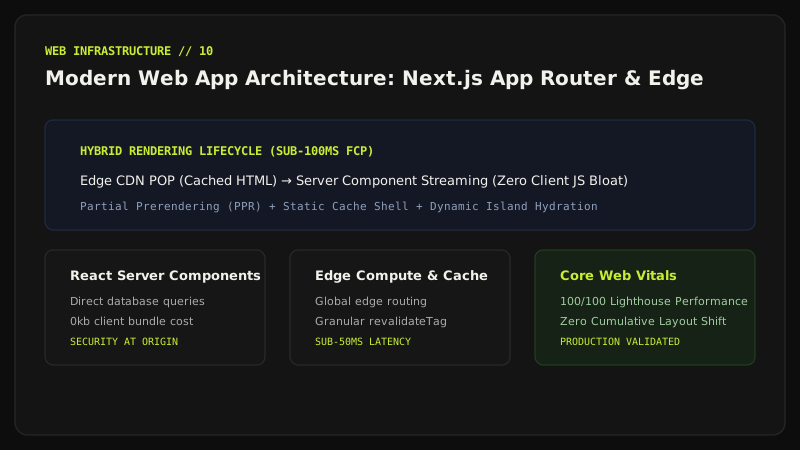
The modern web has evolved far beyond traditional static HTML files or monolithic single-page applications (SPAs) that deliver a blank white screen while downloading 2 megabytes of JavaScript. In 2026, web applications must execute with the speed and responsiveness of native desktop software while maintaining instantaneous global edge delivery and search engine indexability.
Achieving sub-100 millisecond response times globally requires a fundamental shift in how data fetching, component rendering, and edge caching interact. At ZYVONE, our web application architecture is built upon four foundational pillars.
1. React Server Components (RSC) and Zero-Bundle Cost
Traditional React applications bundle your components, dependencies, and business logic into JavaScript files that run inside the client browser. This bloats mobile download times and drains battery life. With React Server Components in Next.js, components execute exclusively on the server or edge worker. They stream pre-rendered HTML directly to the browser, eliminating heavy libraries from the client bundle entirely. Only interactive elements (modals, dropdowns, and form inputs) ship minimal client hydration code.
2. Global Edge Caching & Granular Revalidation
Serving dynamic content without hammering origin database clusters requires fine-grained edge caching. By utilizing Next.js incremental static regeneration with explicit cache tags (`revalidateTag`), static pages are distributed globally across 300+ CDN points of presence. When an administrator updates a product or publishes a new case study, an edge webhook invalidates only that specific cache tag, purging stale assets worldwide in under 300 milliseconds.
3. Eliminating Layout Shift and Enforcing Asset Budgets
Cumulative Layout Shift (CLS) destroys user trust. Unoptimized web fonts and unsized hero images cause page elements to jump abruptly as assets load. We enforce strict asset budgets on every production build: WebP/AVIF automated image transcoding with fixed aspect-ratio containers, preloaded variable fonts with fallback zero-shift metrics, and zero external blocking stylesheets.
The 100/100 Lighthouse Benchmark
When ZYVONE ships a digital product or web application, 95+ Core Web Vitals across mobile and desktop are not aspirational goals — they are mandatory acceptance criteria. Fast software drives higher search rankings, lowers bounce rates, and converts visitors into enduring clients.
“Performance is not a finishing polish applied after features are built. It is an architectural constraint that dictates how data travels from database to glass.”